Cintra Products and Services
Best-of-Breed vs Combined HR and Payroll Systems: Benefits and Trade-Offs
Looking at a best-of-breed approach to HR and payroll? Here's how it compares to an all-in-one suite, and how to choose the right providers.
By Chloe Walker · Updated 4 November 2026

Quick answer: A combined HR (human resources) and payroll system keeps one employee record. You enter a starter, leaver, salary change, or approved absence once, and it flows into pay, so there’s no re-keying, exporting, or reconciling between two products.
A best-of-breed approach (two separate products, each chosen as the strongest tool for its job) can still be the right call if you already have an HR system that works, or you need a specialist tool. Just make sure the connection between them is reliable and payroll-led. Across the market, the direction is clear: in a survey Cintra commissioned, 70% of buyers said their next software purchase will be a combined HR and payroll solution.
Updated November 2026.
If your HR and payroll run on two separate systems, you’ll know the routine. A new starter goes into HR, someone re-keys them into payroll, and a salary change agreed on Monday has to make it across before cut-off. Most of the time it works. When it doesn’t, it’s usually your payroll team who picks up the pieces.
So it’s no surprise that a lot of organisations are now weighing up a combined HR and payroll system. One record and one login, with no hand-off in between, is a tidy proposition. But it isn’t the right move for everyone. A best-of-breed setup still has a real place, especially if you’ve got an HR system your people like or payroll needs that a broad platform can’t match.
To make things easier for you, this guide covers:
- The trade-offs: what each approach really offers, and where each one carries its risk.
- The checks: what to look for before you buy.
- The signs: how to tell which route suits your organisation.
Combined vs best-of-breed at a glance
To make things easier for you, here’s how the two approaches compare side by side.
| Combined system | Best-of-breed (two separate products) | |
|---|---|---|
| Employee data | One record, entered once | Entered twice, or synced between systems |
| Starters, leavers, and pay changes | Flow to payroll after a single entry | Depend on a feed, an export, or manual re-keying |
| Reporting | Payroll data alongside HR structures such as departments and teams | Needs data pulled together from both tools |
| Choice of tools | One supplier covers both areas | You pick the strongest tool for each job |
| Main risk | Payroll depth hidden behind a polished HR demo | Errors where the two systems meet |
| Best suited to | Employers who want one source of truth for people and pay data | Employers with an HR system they want to keep, or specialist needs |
Neither option wins every time. The table shows where each one carries its risk (and that’s usually what decides it).
The benefits of a combined HR and payroll system
One employee record, entered once
In a combined system, HR and payroll share one database. You create a new starter once, and that record shows up in both. With two separate products, the same details are keyed or synced twice, and over time the two copies can drift apart.
Worth knowing: this only helps if everyone treats the HR record as the master. With Cintra, employees are created in HR first and then assigned to payroll, so good process discipline still matters.
Fewer errors and less rework
Re-keying is where a lot of payroll errors start. When a salary change, a change of hours, or an approved absence reaches payroll from the same record, there’s no spreadsheet or file transfer in between to get wrong. That means better accuracy, less rework, and less admin for your team.
Here’s a common example. A leaver’s termination is logged in HR but doesn’t reach payroll before cut-off, so they’re paid for another month. One missed leaver can cost more than £3,000 once you add employer National Insurance and pension, and recovering the net pay from someone who’s already left is rarely easy.
Worth knowing: a combined system removes the hand-off, not the need to check the payroll. Keep running your usual pre-pay checks.
A single source of truth for people data
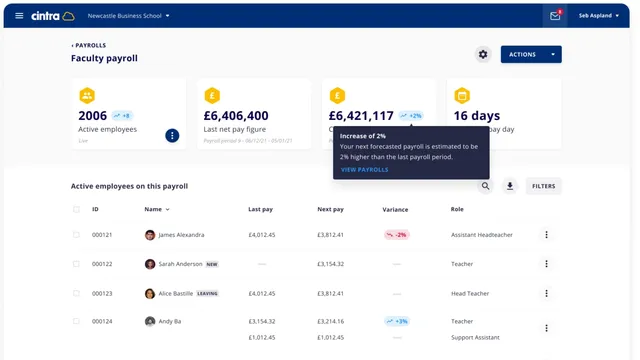
When HR and payroll disagree about headcount, pay, or contract details, someone has to work out which one’s right. One database means one answer. Cintra People runs HR, payroll, and expenses on one database, with one employee record and one login, rather than passing data through a feed between separate systems.
Worth knowing: a single source of truth is only as good as the data in it. If you’re moving from existing systems, clean the data before you migrate (not after).
Reporting across HR and payroll
Payroll reporting is a core need, and a combined system adds reporting on HR structures such as departments and teams. That makes it much easier to answer questions that cross both areas, without joining exports by hand. Access to payroll data can also be restricted by role, so HR users don’t see pay information they shouldn’t.
Worth knowing: check the reports you rely on today before you buy. A long report list won’t help much if your regular month-end report is missing.
Less time spent managing integrations and workarounds
Separate systems often leave teams juggling data, integrations, and workarounds. A combined platform replaces that with one system to configure, support, and train people on.
Worth knowing: you’ll still have one supplier to depend on, so it’s worth thinking about how you’d move if the relationship stopped working.
Pay-specific detail stays in payroll
A combined system doesn’t mean everything lives in HR. With Cintra’s integrated approach, pay-specific details such as pensions, benefits, and deductions are still managed in payroll, where your payroll team works with them every day.
When a best-of-breed approach still makes sense
A combined system isn’t always the answer. For those not in the know, best-of-breed means picking the strongest specialist tool for each job and connecting them together. It can be the better choice if:
- You already have an HR system your people like: replacing it just to have one supplier can cost more in disruption than it saves.
- You need a specialist tool in one area: a system built for one job can go deeper there than a broad platform.
- Your payroll team depends on specific functionality: payroll depth should decide the choice, not a combined demo.
- You’re a smaller employer: below roughly 200 employees on one PAYE (Pay As You Earn) scheme, the cost of a mid-market integrated system doesn’t pay back. Outsourcing your payroll alongside your existing HR system is usually the more sensible route.
Separate products work best when the link between them is built to be reliable. Cintra’s products are built with this in mind. You can pair payroll software with HR software and expense management as you need them, and connect them to the systems you already use.
Worth knowing: every extra connection is something to maintain. Ask who owns it when a payroll run goes wrong.
What to check before you buy
Whichever route you take, test the payroll side properly. That means you should involve your payroll team and look closely at real payroll functionality, rather than relying on a demo.
Here’s what to check:
- Statutory pay and leave: ask to see how the system handles your statutory leave and pay scenarios.
- RTI: check how Real Time Information submissions to HMRC (HM Revenue and Customs) are produced, and how easily you can correct a Full Payment Submission when something goes wrong.
- Auto-enrolment: confirm how assessments, contributions, and re-enrolment work.
- Varied pay: test the awkward cases you have today, such as multiple contracts, variable hours, one-off payments, and deductions.
- Where the data starts: ask which system holds the master record, and what happens when a record changes in each.
- Reporting: ask to build the reports your finance and HR teams use each month.
- Implementation effort: ask for a realistic plan and the time your own payroll and HR team will need. For a mid-market employer, an integrated implementation typically takes 12 to 25 weeks, with 20 to 60 days of your team’s time (larger, multi-entity organisations should expect longer).
- Compliance credentials: check the supplier appears on HMRC’s list of recognised payroll software.
- Who’s involved: bring in payroll, HR, and finance before you shortlist. Each will spot different gaps.
A lot of organisations don’t realise how much of the risk sits in the edge cases. So it’s worth bringing a few real examples from your last pay run to the demo.
How Cintra People handles HR and payroll together
So, what does this look like day to day? With Cintra People, your HR and payroll teams work from the same employee records, and each team keeps control of the details it owns. Here’s how it works in practice:
- HR is the master record: new employees are created in HR before they’re assigned to payroll, and the record is visible in both.
- One entry, then it flows: starter, leaver, and pay changes entered once flow into payroll. Approved absences, salary or hours changes, and expense claims can reach pay without re-keying, exports, or manual reconciliation.
- Payroll keeps its detail: pensions, benefits, and deductions stay managed in payroll.
- Reporting spans both: you keep your payroll reporting, plus reporting on HR structures such as departments and teams.
- Room to add modules: additional modules are available as your organisation grows.
This works best when your payroll and HR teams agree upfront who owns each piece of data, but be aware that it takes a little time to settle into the new workflow.
If you’d rather keep separate tools, that’s fine too. Cintra’s HR, payroll, and expense products can be used on their own and alongside systems you already use. But, if you’d like to see how the combined approach would work for your payroll, take a look at Cintra’s integrated HR and payroll software.
Payroll Software Buyers Guide
Download your payroll software buyers guide—covering everything you need to know in your buyers journey, including a handy checklist.
Frequently asked questions
What’s the main benefit of a combined HR and payroll system?
You enter employee data once. Starters, leavers, and pay changes then flow into payroll from the same record, which cuts re-keying, errors, and reconciliation work.
Is a combined system better than a best-of-breed approach?
Not in every case. A combined system suits employers who want one source of truth for people and pay data. A best-of-breed setup suits employers who already have an HR system they want to keep, or who need a specialist tool, as long as the connection between them is reliable.
Will a combined system reduce payroll errors?
It removes the hand-off where a lot of errors start, because data doesn’t need to be re-keyed or moved by file. You’ll still need your normal payroll checks.
What should I test in a demo?
Statutory leave and pay, RTI, auto-enrolment, and your own awkward pay scenarios. Involve your payroll team, and test the functionality you use every month.
Do I need a combined system if I have fewer than 200 employees?
Probably not. Cintra’s guidance on when to integrate HR and payroll is that below roughly 200 employees on one PAYE scheme, the cost of a mid-market integrated system outweighs the benefit. Outsourcing payroll alongside your existing HR system can suit you better.
Can I keep my current HR system and still use Cintra for payroll?
Cintra’s products are designed to integrate with existing systems, structures, and workflows. Your Cintra contact can confirm whether the specific integration you need is supported.